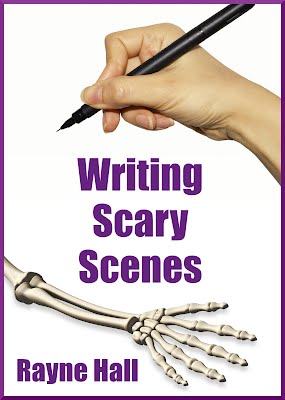
Are your frightening scenes scary enough? Learn practical tricks to turn up the suspense. Make your readers' hearts hammer with suspense, their breaths quicken with excitement, and their skins tingle with goosebumps of delicious fright.
This book contains practical suggestions how to structure a scary scene, increase the suspense, make the climax more terrifying, make the reader feel the character's fear. It includes techniques for manipulating the readers' subconscious and creating powerful emotional effects.
Use this book to write a new scene, or to add tension and excitement to a draft.
You will learn tricks of the trade for "black moment" and "climax" scenes, describing monsters and villains, writing harrowing captivity sections and breathtaking escapes, as well as how to make sure that your hero doesn't come across as a wimp... and much more.
This book is recommended for writers of all genres, especially thriller, horror, paranormal romance and urban fantasy.
I don’t read many books on religion and faith (translated, that would mean none). Samir’s book captured me by its subtitle “Reflections of a Muslim Atheist Jewish Christian”. Does such a thing exist, I had to ask myself.
I am Christian Catholic, baptized and confirmed, raised in a family that puts high emphasis on religious values and customs. Since I was a kid, I was taught that I’m supposed to respect other religions, but never cross the line. I was taught that this is the way it’s supposed to be, that “we” are better than “them”. Yet, it didn’t explain why I should keep at bay people I considered my friends. Because they belong to a different religion?
That could barely convince me. If you teach me to believe in a God that loves all creatures alike, does that mean he doesn’t love my little friends just because they are Muslims/ Jews/ atheists?
“Grace did not start with Christianity and it will not stop with Christianity.” p 71
-->
Reading Samir’s book was a great experience. He raises the question of religion vs. spirituality, stating that they don’t need to go hand in hand if it means religion is restraining our freedom to seek blessings in life. People are blessings. They expand and enrich our life. Yet, we are defined in our lives by what we are thought in our families and Sunday School groups.
-->
“We have come to the place where millions of people say, „Religious? No thanks. I'd rather be spiritual than religious.” But our departure from religion is at the very same time a departure from its rich treasures of community, insight, art, practice, organized action and hard lessons. Without religion, we find ourselves isolated, incoherent, and naive on our spiritual journeys.” p 16
-->
“It’s really all about God is another way to say It’s not really all about religion.”
That’s what I find to be the thread line of this book. As a founder and Christian co-leader of Faith House Manhattan, an interfaith “community of communities", Samir promotes a new view on religion, one that accepts blessings of people of other religions and confessions. He calls for a “reformation” within three large monotheistic religions and atheism and strives to tear down walls that separate us. Coexistence is possible without compromising anyone’s dignity and beliefs. I find this to be necessary today, when our lives are inevitably influenced by “others”. Many of them are our good friends. Are we going to disdain them or accept that they can influence us for better?
-->
It’s all about God: Reflections of a Muslim Atheist Jewish Christian is coming out in bookstores tomorrow, September 22nd. For much more information, podcasts, book excerpts, orders and interviews, I recommend you check Samir’s FiledBy page.
Thank you, Samir, for the chance to review this great book!